
1Department Of Pharmaceutical Chemistry, SAL College of Pharmacy, opp. Science City, Sola Road, Ahmedabad-380060
2Department Of Pharmacy, SAL College of Pharmacy, opp. Science City, Sola Road, Ahmedabad-380060
In the face of mounting global health challenges, the simultaneous burden of malaria, cancer and cardiovascular disease presents an urgent call for therapeutic innovation. The growing complexity of these diseases poses significant challenge to conventional therapeutic approaches. Monotherapy often falls short due to issues like drug resistance, patient non-compliance and multifactorial disease mechanism. In this context, hybrid drug technology has emerged as a promising alternative offering a synergistic strategy by integrating multiple pharmacophores into a single molecular framework giving a compiling solution to multifaceted challenges by targeting heterogeneous pathophysiology an emerging drug resistance. In this present review article we will explore what hybrid drug technology is, its importance, mechanistic versatility and therapeutic promise of hybrid molecules that integrate anti-malarial scaffold, cytotoxic agents and cardio protective moieties. We will look into what is a linker, its types, selection criteria and advantages will be mentioned that are rarely covered in any article. Additionally, overview on various hybrid drug molecules in different disease condition has been encompassed to the parent moiety.
In the ever-evolving landscape of pharmaceutical innovation and an era where complex diseases from cancer to many infections demands multidimensional therapeutic strategies, hybrid drug technology has emerged as a transformative approach that blurs the boundary between traditional pharmacology and molecular engineering.1,2 This development shows a paradigmatic shift by joining the gap between chemistry and clinical need. Rather than combining dose in fixed concentrations, using polypharmacy approach or conventional therapies, hybrid drugs are rationally designed molecules that integrates two or more pharmacophores(either identical or distinct) into a single chemical entity which offers a unified mechanism to tackle multifunctional pathologies.1 These hybrid molecules are often referred to as multifunctional drugs or dual action agents, which are engineered to simultaneously target multiple biological pathways.3 This paradigm not only enhances therapeutic efficacy but also addresses challenges such as drug resistance, poor bioavailability, and patient compliance. These hybrid drugs are mainly of 3 types, i.e.
To design and discover newer drugs was the toughest target to achieve as hit and lead stages becomes more crucial, hence the need for hybrid drugs aroused. Hybrid drugs are also known as multi-target directed compound, multifunctional ligands, chimeras and etc.
For emerging a hybrid drug, linker plays a vital role. Linkers are chemical structure that connects two or more different therapeutic agents, creating a single molecule with potentially enhanced properties.4 Notably, Telisotuzumab Vedotin (Emrelis) has successfully transitioned from trials to become a marketed anticancer hybrid, proving its efficacy in clinical practice. Simultaneously, cutting-edge research is advancing at the University of California, where our Astimezole-Chloroquine hybrid and an innovative zatebradine and Aryloxypropanolamine hybrid are showing exceptional promise in preclinical trials for treating resistant malignancies. Furthermore, our ongoing Clinical Research in the antifungal sector is bridging the gap between design and delivery, aiming to provide highly potent, single-entity solutions for complex fungal infections.8,9,12,14
Linkers: the unsung architects of bioactivity.
Linkers serves as the molecular bridges used to bind distinct pharmacologically active units into one concise hybrid drug. Though overlooked due to its small size, the linker is far more than just glue. It hold the power to contract, influence and even activate the behaviour of the hybrid drug. The objective is to preserve or enhance the individual activities of the pharmacophores, while also imparting synergistic therapeutic effects, improved targets or optimised pharmacokinetic property. With respect to the manner of attachment of the individual components, particular consideration should be given to the (i) mechanism of action of the individual ligands, (ii) nature of the linker unit employed[10], (iii) distance between the individual components and,(iv) molecular geometry, if known, of the individual ligand binding sites.4,5 Although hybrid drugs are inherently difficult to synthesize and characterize due to their high molecular weight and complex architecture, recent innovations in linker technology have successfully surpassed these traditional disadvantages. Modern linkers are no longer just passive spacers but have evolved into sophisticated, stimuli-responsive bridges—such as pH-sensitive, redox-active, or enzyme-cleavable motifs—that ensure the simultaneous and stable delivery of diverse pharmacophores specifically to the tumor microenvironment. This review article highlights several groundbreaking hybrid drugs that have redefined the 2024–2025 clinical landscape5,7,8
Types of linkers:
There are basically 2 class of linkers <i.e.
1. Directly linked hybrid drug: connect via functional group
2. Spacer linked hybrid drugs: this is sub classified as:
2.1: cleavable linkers:
Ester linked linker which bound through plasma esterase and release 2 different drugs.
Example: No-Aspirin, 5-Flurouracil Cytarabine, VNLG/114
It includes:
2.2: Non- cleavable linkers:
Non hydrolysed bonds make them connected and shows chemically as well as enzyme stability. Example: PHENYLINDOLE-ANILINE MUSTARD, ESTRADIOAL-ANILINE MUSTARD. It includes:
Linker should possess properties like stability, cleavage specificity, non-immunogenic, biocompatible, and non- toxic. As these entities have architectural complexity, it requires guided synthesis and robust analytical validation. Over the past decades, advancements in medicinal chemistry, molecular modelling and high throughput screening have accelerated the rational design of hybrid compounds tailored for specific therapeutic outcomes.
Design considerations for choosing linker:
1. Stability in systemic circulation.
2. Trigger to release in tumour environment.
3. hydrophilicity/lipophilicity balance.
4. Length and flexibility to prevent steric hindrance.
5. Biocompatibility and non-toxicity of the linker and its by-product.
Role of linkers:
Far from being passive connectors, linkers play active role in:
The incorporation of linker in hybrid rug technology holds strategic importance and humorous advantages:
Hybrid drug techniques are now actively explored across a range of therapeutic areas including oncology, infectious disease, and cardiovascular disorder and central nervous system conditions. Here, in this article we will discuss few hybrid drug molecules used in various diseases like:
There are numerous hybrid drugs and hybrid drug molecules present and continuously gets researched for this type of broad spectrum diseases, the predicted ratio for hybrid drugs for above mentioned diseases is shown below:
Fig (A): Hybrid Drug ratio for various diseases5.
Experimenital
Hybrid Drugs for Cancer
Introduction
“CANCER”, it is one of the most lethal diseases in the world known till. In 2024, nearly 9.7 million cancer-related deaths have occurred. It has become a burden leading to deaths globally. About 1 in 5 people develop cancer in their lifetime and 1 in 12 women die from this disease. There are various treatment types which fully cure in some cases and may fail prominently. There are 2 types of treatment i.e. LOCAL treatment and SYSTEMIC treatment.
For local treatment we have:
For systemic treatment we have:
There are various classes of drugs used in cancer treatment for different forms of cancer; it could be localised cancer like breast cancer, hepatic cancer, colon cancer, systemic cancer etc. Though there’s a very broad classification of drugs for anti-cancer, it lack efficacy at some level. Hence a need for hybrid drug in cancer therapy is required which properly attacks the targeted cell and shows greater potency. It includes two different pharmacophores which one combination get us the best results. Human anatomy and physiology is very wide and hence is gets easier to target specific cell, tissue, organ with the help of only “required drug”. In this specific portion various hybrid molecules of different classes are mentioned where the pharmacophores are joined together with a linker to get a desired effect in reducing cancer cells or inhibiting cancer.
Hybrid Drug Targeting HDAC And DNA Alkylation:
The recent development of hybrid drug which specifically target histone deacetylase (HDACs) and DNA through alkylation represent a novel approach in anti-cancer treatment. The dual function includes epigenetic modulation with cytotoxic DNA damage with shows synergistic mechanism and enhanced therapeutic efficacy.
Genotoxic stress and DNA alkylating agents covalently modify DNA bases primarily at N7 position of guanine leading to various steps:
Epigenetic reprogrammed cellular environment is observed by adjoining these alkylating moieties with HDAC inhibitors as it provides targeted genotoxic stress.
Fig(B): Structure Of Vorinostat-Bendamustine Hybrid Drug.
In this hybrid (NL-101) Two moieties which are fused are Vorinostat ( HDAC inhibitor )and bendamustine ( DNA alkylators).NL-101 is engineered by directly substituting the side chain of bendamustine with hydroxamic acid moiety of vorinostat(SAHA) effectively merging both functional groups without an additional spacer or traditional linker.7 Thus it avoids potential issues with metabolic breakdown or linker instability and supports coordinated delivery of HDAC inhibition and DNA damaging actions. When administered, this hybrid enters in blood stream and reaches tumor cells as an intact molecule. Once it reaches inside cancer cell the alkylating part causes DNA crosslinks leading to strand breakage.8 The HDAC-inhibiting part causes accumulation of acetalylated histone and proteins which eventually affect gene expression and trigger programmed apoptosis.
These actions are coordinated, not sequential or independent on breakdown.
IC50 value for HDAC receptor (1-6) is 10nm – 107nm while that of NCI 60 which is a 60-unit long chain has IC50 value 2.2µm. This hybrid shows greater inhibitory constant as compared to bendamustine with IC50=7.7 µM.?
Table-1: Comparative Features of Hybrid Drugs with Bendamustine and Vorinostat.
|
Sr |
Feature |
Nl-101 Hybrid |
Bendamustine Alone |
Vorinostat (Saha) Alone |
|
1 |
DNA -Alkylation |
Yes, Inherited |
Yes |
No |
|
2 |
HDAC -Inhibition |
Yes, Inherited |
No |
Yes |
|
3 |
Cell-Cycle Arrest/ Apoptosis |
Yes, Dual Mechanism |
Yes, DNA Damage |
Yes, History Changes+ DNA Damage |
|
4 |
In-Vivo Efficacy |
Yes, Superior In AML Mouse Models |
Yes, But Less Effective |
-, Not Tested In This Combination. |
Merits of HDAC inhibitor hybrids:
Hybrid Drug Targeting HDAC Inhibitors and Topoisomerase:
This hybrid molecule comprise the fusion of two pharmacophpres i.e. HDAC inhibitor and a TOPOISOMERASE which are fundamentally distinct yet they are interdependent for neoplastic proliferation. As referred before, HDAC are epigenetic modulators as they catalyse deacetylation of histone and non-histone proteins which results in silencing of tumour suppressor genes and maintenance of an undifferentiated cellular phenotype. On the other hand, TOPOISOMERASE are the enzymes that modulate topological state of DNA with on-going vital processes like replication, transcription, and chromosomal segregation.10 Inhibiters of both topoisomerase- 1 and topoisomerase- 2 are the agents which breaks the DNA strand and stalling the replication fork which results in cytotoxic activity. Within this hybrid molecule we will study the drug prepared from hydroxamic acid pharmacophpres (vorinostat, a HDAC inhibitor) and a camptothecin analogue (topoisomerase -1 inhibitor) which showed potent anti-cancer activity, reduced drug resistance, and improved pharmacokinetic profile in pre-clinical model.
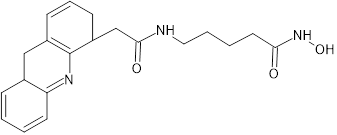
Fig(C): Structure Of Daca-Vorinostat Hybrid Drug.
This hybrid involves two moieties i.e. a DACA (N- [2-(dimethyl amino) ethyl] acridine-4-carboxomide) which a DNA intercalating cytotoxic agent and vorinostat which is a histone deacetylase inhibitor gets us a new drug molecule which has genotoxic and epigenetic variability in cancer cells.11 DACA is a topoisomerase-2 inhibitor which when bind to DNA disrupts replication and transcription of DNA. And thereby breaking the double strand of DNA leading to apoptotic cell death.It allows to target on hypoxic tumour cells that overcome few form of drug resistance linked with classical chemotherapeutics. When vorinostat and DACA is administered through hybrid mode, increment in therapeutic action and potency is observed. It offers a prolonged effect on cancer cell.
Table -2: IC50 values for different receptors.
|
Receptor |
IC50 Values |
|
HDAC-1 |
16.6nm |
|
HDAC-6 |
2.2nm |
|
DU-145 |
0.16µm |
|
PC-3 |
0.31µm |
Some features of this hybrid molecule:
Brand name – Emrelis, Teliso-V


Sanmey Pradhan*, Yashvi Shah, Vineet Talele, Sujal Rathod, Unlocking Synergistic Action: Harnessing Hybrid Drugs for Better Therapeutic Outcomes, Int. J. Med. Pharm. Sci., 2026, 2 (3), 128-157. https://doi.org/10.5281/zenodo.18996579
 10.5281/zenodo.18996579
