Department of Pharmacy Sun institute of Pharmaceutical science and Research (SIPER), Lahar Bhind, (M.P), India 477445
The present study aimed to formulate, optimize, and evaluate fast-dissolving oral films of Opipramol dihydrochloride using the solvent casting technique to enhance patient compliance, achieve rapid onset of action, and improve therapeutic efficacy. Preformulation Studies. The preliminary characterization of Opipramol dihydrochloride revealed that the drug is a yellow, odorless, bitter powder, consistent with standard descriptions. Solubility studies indicated that the drug is freely soluble in water, 0.1 N HCl, and chloroform, and soluble in methanol, ethanol, 0.1 N NaOH, and phosphate buffer (pH 6.8). These findings confirmed the suitability of the drug for film formulation, as its solubility supports rapid dispersion and absorption in the oral cavity.
Mouth dissolving films offers an elegant route for systemic drug delivery. The improved systemic bioavailability results from bypassing first pass effect and better permeability due to a well-supplied vascular and lymphatic drainage. Also, large surface areas of absorption, easy ingestion and swallowing, pain avoidance make the oral mucosa a very attractive and selective site for systemic drug delivery. Recent developments in the technology have presented viable dosage alternatives from oral route for wide variety of group of patients. Buccal drug delivery has lately become an important route of drug administration. Various Bioadhesive mucosal dosage forms have been developed. Fast-dissolving drug- delivery systems were first developed in the late 1970s as an alternative to tablets, capsules, and syrups for pediatric and geriatric patients who experienced difficulties in swallowing traditional oral solid-dosage forms.
LITERATURE REVIEW
Mishra et al., (2024) worked on Impurities identified by R.L. Fine Chemical, Bangalore, during the manufacturing of bulk drugs like opipramol, pargeverine and propiverine were synthesized and characterized by various analytical techniques such as TLC, FTIR, 1H- MNR, FABMS and Elemental analysis. Impurities (1a-e) were synthesized as per scheme 1 which were identified during manufacturing of opipramol bulk drug and screened for their anti-anxiety activity by elevated plus-maze method. The pharmacological screening showed that impurities.
Wadher et al., (2023) developed or dispersible films (ODFs) of Montelukast Sodium as an alternative to fast dissolving tablets which is attributed to their faster dissolution rate, higher durability, and better patient compliance. Owing to its rheological and also various functional properties, many researchers tried to discover some of the pharmaceutical applications of L. sativum in the development of various dosage forms, in addition to its therapeutic studies.
Cîrcioban et al., (2023) aimed the thermal stability and kinetic evaluation of opipramol dihydrochloride (OPI 2HCl) performed in an oxidative atmosphere on the 30–450 °C temperature range using multiple heating rates (β = 2.5, 5, 7, 10 and 12 °C min−1). Thermogravimetric and derivative thermogravimetric analysis proved the stability of OPI 2HCl up until 150 °C followed by a single mass loss of approximately 80% up until 350 °C.
Kamali et al., (2022) fabricated emulsion-electrospinning the curcumin (CUR)-loaded PVPK90 nanofibers. The nanofibers were prepared using the central composite design. The selected variables were drug concentrations, flow rates, acetone content, and organic phase percentages and the evaluated responses were diameters, loading %, wetting and disintegration times.
METHODS:
Preformulation studies
Preformulation studies are an important tool for determination of physical and chemical properties of the drug before incorporating it in formulation development program me. The nature of the drug highly affects the processing parameters like method of preparation, loading efficiency, compatibility and pharmacokinetic response of the formulation. Preformulation studies are indispensable protocols for development of safe, effective and stable dosage form as well (Albert and Serjeant, 1984; Yalkowiski and Roseman, 1981).
Identification Test using FTIR Spectroscopy:
Infra- red spectrum is an important record which gives sufficient information about the structure of a compound. This technique provides a spectrum containing a large number of absorption band from which a wealth of information can be derived about the structure of an organic compound. The region from 0.8 µ to 2.5 µ is called Near Infra-red and that from 15 µ to 200 µ is called Far infra-red region.
Loss on drying:
Loss on drying directly measuring by IR moisture balance. Firstly calibrate the instrument by knob then take 5.000 gm sample (powder) and set the temp at 100°C to 105°C for 5 minutes and constant reading set the knob and check % moisture (European Pharmacopoeia, 2004).
Melting point:
It is one of the parameters for the purity of drugs. In case of pure chemicals, melting points are very sharp and constant. Since the drugs contain the mixed chemicals, they are described with certain range of melting point. A small quantity of Opipramol dihydrochloride was placed into a fusion tube. That tube is placed in the melting point determining apparatus containing castor oil. The temperature of the castor oil was gradual increased automatically and read the temperature at which powder started to melt and the temperature when all the powder gets melted.
RESULT:
Identification test by FTIR
Infrared spectrum of any compound given information about the functional group present in particular compound. An infrared spectrum of drug was taken using KBr pellet method. Various peaks in IR spectrum were interpreted for presence of different group in the structure of drug.
Table 1: FTIR Interpretation of Opipramol dihydrochloride
|
S. No. |
Observed Wavenumber (cm?¹) |
Type of Vibration |
Functional Group |
|
1 |
3364.44 |
N–H stretching |
Primary/secondary amine group |
|
2 |
2916.43 |
C–H stretching |
Aliphatic C–H (alkyl groups) |
|
3 |
1647.94 |
C=N or aromatic C=C stretching |
Aromatic/heterocyclic ring system |
|
4 |
1467.10 |
C–C stretching |
Aromatic ring |
|
5 |
1227.44 |
C–N stretching |
Tertiary amine |
|
6 |
1086.97 |
C–O stretching or other side chains |
Ether or side chain functionalities |
In-vitro drug release study of Formulation F6 and marketed formulation
The in-vitro drug release study was performed to compare the release behavior of the optimized formulation F6 with that of the marketed formulation of Opipramol dihydrochloride. The results demonstrated a significant difference in the rate and extent of drug release between the two formulations. Formulation F6 exhibited a rapid and higher cumulative drug release compared to the marketed formulation throughout the study period. Within the first 1 minute, F6 released 36.65% of the drug, whereas the marketed formulation released only 22.65%, indicating a faster onset of drug release from the prepared film. This rapid initial release can be attributed to the hydrophilic nature of the polymer matrix and the presence of a suitable plasticizer, which facilitated quick hydration and disintegration of the film upon contact with the dissolution medium. By the 6th minute, F6 had released 89.98% of the drug, while the marketed formulation released only 53.32%, demonstrating a substantially higher release rate for the prepared film. At the end of 10 minutes, F6 achieved 98.12% cumulative drug release, compared to 70.15% for the marketed product. The nearly complete release within 10 minutes suggests that the film formulation ensures efficient drug diffusion and solubilization.
Table 2: In-vitro drug release study of Formulation F6 and marketed formulation
|
Time (Min.) |
Cumulative % Drug release |
|
|
F6 |
Marketed formulation |
|
|
1 |
36.65 |
22.65 |
|
2 |
59.98 |
35.45 |
|
4 |
76.65 |
40.36 |
|
6 |
89.98 |
53.32 |
|
8 |
96.68 |
60.25 |
|
10 |
98.12 |
70.15 |
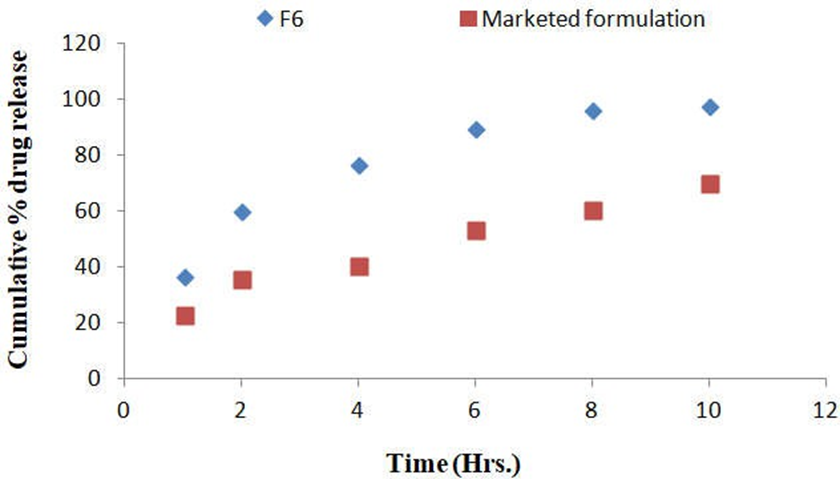
Figure 1: Cumulative % Drug release
Table 3: Results of In-vitro release kinetics of optimized formulation F6
|
Time (min.) |
Square Root of Time(h)1/2 |
Log Time |
Cumulative*% Drug Release |
Log Cumulative % Drug Release |
Cumulative % Drug Remaining |
Log Cumulative % Drug Remaining |
|
1 |
1.000 |
0.000 |
36.65 |
1.564 |
63.35 |
1.802 |
|
2 |
1.414 |
0.301 |
59.98 |
1.778 |
40.02 |
1.602 |
|
4 |
2.000 |
0.602 |
76.65 |
1.885 |
23.35 |
1.368 |
|
6 |
2.449 |
0.778 |
89.98 |
1.954 |
10.02 |
1.001 |
|
8 |
2.828 |
0.903 |
96.68 |
1.985 |
3.32 |
0.521 |
|
10 |
3.162 |
1.000 |
98.12 |
1.992 |
1.88 |
0.274 |
CONCLUSION
The present study aimed to formulate, optimize, and evaluate fast-dissolving oral films of Opipramol dihydrochloride using the solvent casting technique to enhance patient compliance, achieve rapid onset of action, and improve therapeutic efficacy.
Preformulation Studies
The preliminary characterization of Opipramol dihydrochloride revealed that the drug is a yellow, odorless, bitter powder, consistent with standard descriptions. Solubility studies indicated that the drug is freely soluble in water, 0.1 N HCl, and chloroform, and soluble in methanol, ethanol, 0.1 N NaOH, and phosphate buffer (pH 6.8). These findings confirmed the suitability of the drug for film formulation, as its solubility supports rapid dispersion and absorption in the oral cavity. FTIR spectral analysis confirmed the presence of characteristic peaks corresponding to N–H stretching (3364.44 cm?¹), C–H stretching (2916.43 cm?¹), C=N/C=C stretching (1647.94 cm?¹), and C–N stretching (1227.44 cm?¹), indicating that the drug retained its chemical identity and compatibility with the selected excipients. The loss on drying (0.275 ± 0.004%) was within acceptable limits, suggesting low moisture content and good stability of the raw drug. The calibration curve for Opipramol dihydrochloride in methanol exhibited linearity in the concentration range of 10–50 µg/ml with a correlation coefficient (r²) of 0.996, confirming adherence to Beer–Lambert’s law and suitability for quantitative estimation in subsequent analyses.
REFERENCES

Aman Savita*, Dr. Avinash Kondalkar, Jogendra Singh, Muraree Lal, Shankar, Formulation and Characterization of Opipramol Dihydrochloride Loaded Fast Dissolving Oral Film, Int. J. Med. Pharm. Sci., 2025, 1 (12), 1-5. https://doi.org/10.5281/zenodo.17779440
 10.5281/zenodo.17779440
